Climbing Apparition Hill and Cross Mountain: What the Climb Really Involves
Climbing Apparition Hill and Cross Mountain looks simple in a photograph and is not simple underfoot. Both paths are bare, sharp limestone, uneven the whole way, with no steps and no handrails, and they punish the wrong shoes within the first ten minutes. This guide is a terrain and preparation piece rather than a devotional one: how long each climb takes, what your knees and your footwear need to handle, and what to do instead if a rocky ascent is not realistic for you. If you would rather have a guide set the pace and the schedule, shrine-focused Medjugorje day trips build proper time at both hills into the itinerary.
Quick answer
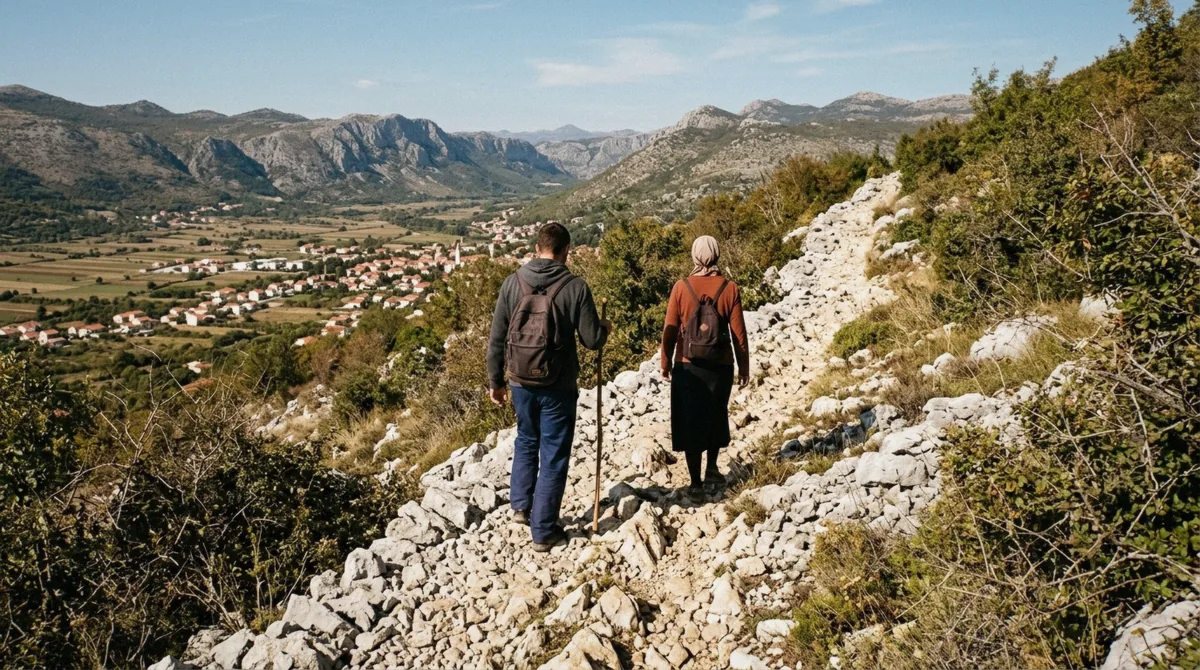
Apparition Hill takes about 30 to 40 minutes up a path of sharp, uneven limestone; Cross Mountain is the harder climb at 45 to 60 minutes up, with no steps, no handrails and no water on either route. Closed shoes with real grip matter more than anything else you pack.
Key takeaways
- Cross Mountain is steeper and longer than Apparition Hill, and pilgrim guides describe it as unsuitable for very young children or anyone with mobility difficulties
- Neither hill has an accessible route or assisted transport; for a flat alternative, see the church, the outdoor altar area and the statue of the Risen Saviour
- The rock is slippery when wet on both climbs, so rain changes the calculation more than heat does
- Some pilgrims climb barefoot as a voluntary devotional practice; the rock is genuinely sharp, and we do not recommend it
- The shrine-focused Dubrovnik day trip and the small-group pilgrimage from Dubrovnik both build unhurried time at the hills into the day
- Carry your own water; there is none on either path
Guided Visits That Build in Real Time at the Shrine
These day trips include unhurried time at both hills rather than a rushed photo stop, with a guide who paces the climb for the group.
 from $133
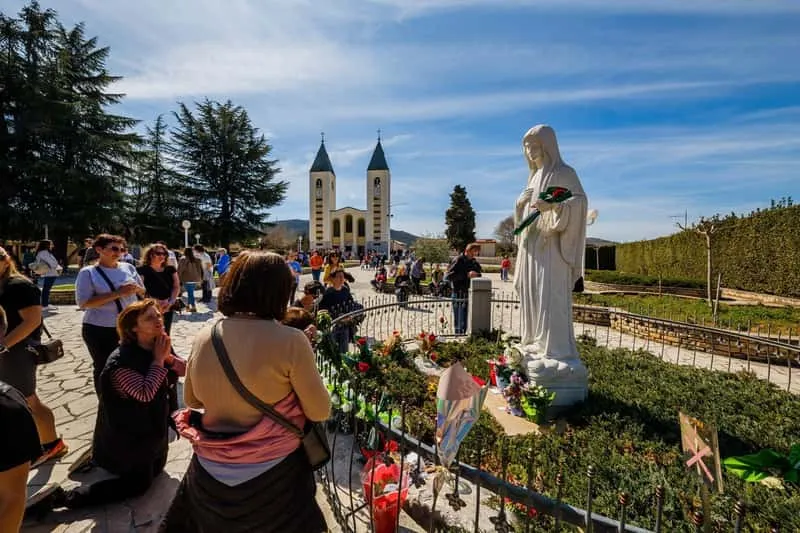
 From Dubrovnik: Međugorje Pilgrimage Small-Group Experience
A spiritual journey with our full-day small-group tour to Medjugorje, one of the most visited pilgrimage sites in the world. Offering a transformative experience of faith and tranquility.
- Small group — intimate pilgrimage experience
- Visit St. James Church and the Blue Cross
- Opportunity to climb Apparition Hill
- Loved by 100% of English-speaking travelers
 from $137
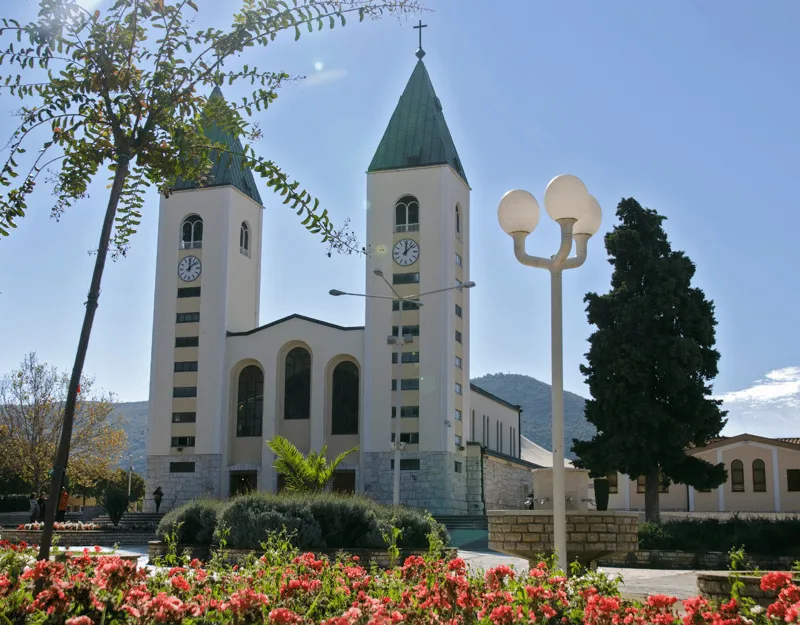
 From Dubrovnik: Medjugorje Pilgrimage Site Day Tour
Visit the Catholic pilgrimage site of Medjugorje on a day tour from Dubrovnik with round-trip transportation. Visit St. James Church and climb Apparition Hill, where the Virgin Mary…
- Dedicated Medjugorje pilgrimage — no Mostar stop
- Visit St. James Church and Apparition Hill
- Round-trip transport from Dubrovnik
- Free cancellation up to 24 hours in advance
The Two Hills, Compared
Same village, two very different climbs. The table below lines up the practical differences before you decide which to attempt, or whether to attempt both.
| Apparition Hill (Podbrdo) | Cross Mountain (Križevac) | |
|---|---|---|
| Climb time up | 30 to 40 minutes | 45 to 60 minutes |
| Climb time down | Similar to the way up | 30 to 40 minutes |
| Terrain | Sharp, uneven natural limestone, no steps, no handrails | Steep, uneven natural rock, stony switchback path, no steps |
| Difficulty | Moderate, manageable for most fit adults | The harder of the two, steep the whole way |
| What's at the top | A white marble statue of Our Lady, Queen of Peace | An 8.56-metre concrete cross, built in 1934 |
| Water on the path | None | None |
| Wet-weather risk | Slippery when wet | Slippery when wet |
Apparition Hill, What the Climb Is Really Like
Apparition Hill, known locally as Podbrdo, rises above the hamlet of the same name and is associated with the first reported apparitions of June 1981. The climb runs 30 to 40 minutes at a normal walking pace, longer for a group stopping to pray a mystery of the Rosary at each marker along the way. That is the honest range: fit and unhurried, expect the lower figure; in a large group with prayer stops, expect the upper one or beyond it.
The Path Itself
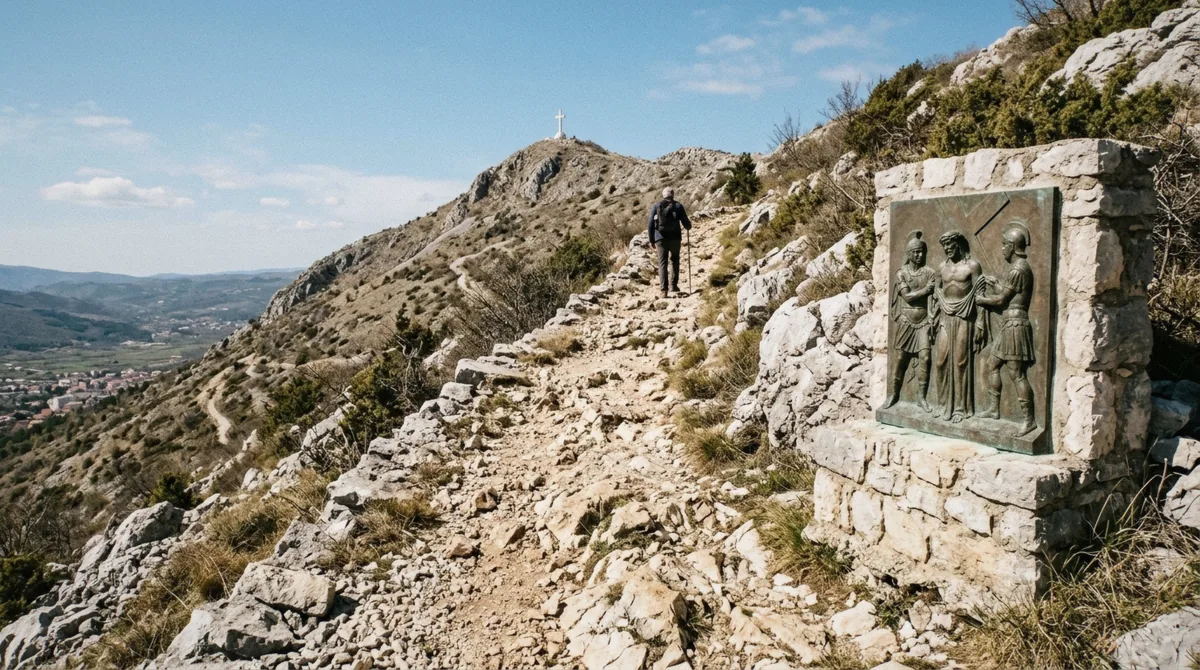
The path is natural, sharp, uneven limestone from base to summit: loose rock, no steps cut into it, no handrails at any point, no paved sections to give your ankles a break. It is slippery when wet, and after rain the smoothest-looking stones are often the most treacherous. Bronze relief markers of the Mysteries of the Rosary line the route, and many pilgrims pause at each one, which is part of why group climb times vary so widely.
What You Pass
The Blue Cross sits near the base of the hill, a natural gathering point before the ascent proper begins. Near the top stands a white marble statue of Our Lady, Queen of Peace, at the site associated with the first reported apparition. From St James Church, the foot of the hill is about 10 minutes on foot across the fields, or 20 to 30 minutes if you follow the road instead, worth factoring in before you commit to a start time.
Cross Mountain, the Harder of the Two
Cross Mountain, known locally as Križevac, is the taller and harder climb of the two, and pilgrim guides are consistent on this point: it is genuinely more demanding than Apparition Hill, not just longer. Reckon on 45 to 60 minutes up and 30 to 40 minutes down, and a full round trip with prayer stops and the walk from the church commonly runs two to three hours in total.
The Terrain
The path is steep, uneven natural rock for the entire ascent, a stony switchback that climbs harder than Apparition Hill from the first few minutes. There are no steps cut into the rock anywhere on the route, and it is slippery when wet, the same as Apparition Hill but on steeper ground where a slip matters more. Pilgrim guides describe the climb as unsuitable for very young children or for anyone with mobility difficulties, and we would not argue with that assessment after walking it ourselves.
The 1934 Cross and the Stations of the Cross
At the summit stands an 8.56-metre concrete cross, and its story predates the reported apparitions by 47 years, which makes it a genuinely interesting fact on its own rather than a devotional claim. Residents of all five villages of the Medjugorje parish built it at the invitation of the parish priest, Fra Bernardin Smoljan, constructing it during January and February 1934 and consecrating it in March 1934, when the first Holy Mass was celebrated at the summit. It was raised for the Holy Jubilee Year marking 1,900 years since the Passion and Death of Christ, a purely commemorative reason that has nothing to do with the visionaries' later reports.
Walking the Stations
The rocky path up Cross Mountain carries the Stations of the Cross, installed in 1987, and many pilgrims stop at each one on the way up rather than treating the climb as a straight ascent. The parish also holds a Stations of the Cross service on the mountain itself on Fridays, at 2pm in the winter half of the year and 4pm in summer. On Apparition Hill, the parish holds the Rosary on Sundays, at 2pm in winter and 4pm in summer.
Both are worth timing your visit around if you want to climb as part of a scheduled group rather than alone.
What to Wear on Your Feet, and the Rest of What to Bring
Footwear is the real issue on both hills, more than fitness or the heat. Closed shoes with real grip are the difference between an uneventful climb and a painful one; the sharp limestone punishes sandals, flip-flops and smooth-soled shoes within the first few minutes, and it does not forgive a slip the way a groomed trail might.
What to Pack
A short list, but every item on it earns its place once you are on the rock.
- Closed shoes with grip; broken in, not brand new
- Your own water; there is none on either climb
- Sun protection for midday climbs, the paths are shadeless the whole way
- A light scarf or shawl for shoulders and knees at the summit shrines
- A torch or phone light if you are climbing before dawn or after dark
- A walking stick or trekking pole if you have any knee concerns
Whether either path is lit at night is not something we could confirm either way, so treat both as unlit and carry your own light if you are climbing before dawn or after dark, which some pilgrims do to avoid the midday heat.
What the Hills Ask of Your Kit, Season by Season
The paths do not change through the year, but what they demand of you does. Neither hill has shade, water or a surfaced section, so the season decides how early you should start and how much you carry.
Last verified: August 2026.
| Season | Start the climb | What the rock is like | What to carry |
|---|---|---|---|
| March to May | Any time before mid-afternoon | Dry most days, greasy after rain | A layer for the wind at the top, one litre of water |
| June to August | Before 09:00 or after 17:00 | Hot, dusty and glaring off the pale stone | Hat, sun cover, two litres of water |
| September to October | Morning or late afternoon | Usually dry, the best conditions of the year | One litre of water and a light layer |
| November to February | Late morning, once the rock has dried | Wet and genuinely slippery; November is the wettest month | Grip soles, a waterproof, a torch if the light is going |
Climbing Barefoot, and Why Some Pilgrims Do It
Barefoot climbing is a real, voluntary devotional practice on both hills, done by some pilgrims as an act of penance. It is a personal choice rather than an expectation placed on visitors, and nothing in the parish programme requires it. What we can say plainly, from the terrain alone: the limestone on both paths is sharp, loose in places, and does not soften for bare feet.
If you see pilgrims climbing without shoes, it is worth understanding as their own chosen practice rather than something to imitate casually. We do not recommend it. Most people who climb do so on a day trip from the coast, and the small-group pilgrimage from Dubrovnik leaves the most usable time on the hill.
Who Should Not Climb, and What to Do on the Flat Instead
Neither hill has an accessible route, and neither has any assisted transport or wheelchair provision, as far as any source shows. That is worth stating plainly rather than glossing over: if you use a wheelchair, have significant mobility limitations, or are travelling with someone who does, both climbs are genuinely not possible as described here, not just difficult.
What's on the Flat
The good news is that the core of the shrine does not require either climb. St James Church itself, the outdoor altar area beside it, and the statue of the Risen Saviour, which stands behind the church rather than on either hill, are all level ground and fully reachable. A visit built around the church and the outdoor altar, skipping both hills, is a complete and legitimate way to experience Medjugorje, and it is what we would suggest for anyone with real knee or mobility concerns rather than attempting Cross Mountain regardless.
Travelling with a mixed group, some able to climb and some not, works better than it sounds if you plan for it. Splitting the group at the base of whichever hill is in question, with one guide or family member staying on the flat with anyone who cannot climb, and agreeing a fixed meeting time and place beforehand, avoids the awkward compromise of everyone climbing at the pace of the slowest member, or nobody climbing at all because the group cannot agree. Reaching the village at all is its own question, and we work through the airports, the buses and the border in our guide to getting to Medjugorje.
Timing Your Climb: Heat, Rain and the Parish Walks
Both paths are shadeless the whole way, exposed rock with no tree cover, which makes midday climbs in July and August genuinely hot work even without an extreme reading to point to. Early morning or the couple of hours before sunset are the more comfortable windows in summer, and they also avoid the crowding that builds around the Friday Stations of the Cross on Cross Mountain and the Sunday Rosary on Apparition Hill.
Rain changes the calculation more than heat does. Both climbs are explicitly described as slippery when wet by every source we checked, and the switchback on Cross Mountain turns genuinely tricky in a downpour. If the forecast is wet, it is worth pushing the climb to a drier window rather than pressing on regardless, particularly on the steeper mountain.
Crowds are the other variable worth planning around. The village fills for the fixed peaks in the parish calendar, and both hills get genuinely busy in the hour before the scheduled Friday Stations of the Cross on Cross Mountain and the Sunday Rosary on Apparition Hill, when large groups climb together at a pace set by the slowest walker in the crowd. If your priority is a quieter, self-paced climb rather than joining the scheduled group prayer, an early morning slot on a weekday, well outside those windows, gives you the path largely to yourself.
If you are still choosing dates, our month-by-month guide to visiting sets out when the village is busiest and when the rock is most likely to be wet.
Deciding Which Climb Is Right for Your Day
If time is short, Apparition Hill is the shorter, gentler climb and gives a genuine sense of the terrain and the shrine without the two to three hours that a full Cross Mountain round trip demands. If you have a full day and steady knees, both hills in one visit is realistic, most pilgrims manage it by spacing the two climbs around a break at the church.
Whichever combination you choose, build in more time than the walking figures alone suggest. Prayer stops, the queue at the Blue Cross, and simply catching your breath on the switchbacks all add real minutes that a bare climb-time estimate leaves out.
Climbing the Medjugorje Hills: Frequently Asked Questions
How long does it take to climb Apparition Hill?
About 30 to 40 minutes at a normal walking pace, longer for a group stopping to pray at each of the Rosary markers along the path.
How hard is Cross Mountain in Medjugorje?
It is the harder of the two hills: 45 to 60 minutes up over a steep, uneven rock path with no steps, described by pilgrim guides as unsuitable for very young children or anyone with mobility difficulties. A full round trip with stops commonly runs two to three hours.
What shoes do you need for Apparition Hill?
Closed shoes with real grip. The path is sharp, uneven limestone the whole way and is slippery when wet; sandals and smooth soles are genuinely risky here, not just uncomfortable.
Why do people climb barefoot in Medjugorje?
It is a voluntary devotional practice some pilgrims choose as penance. The rock is sharp on both hills, and we do not recommend it; it is a personal choice, not something expected of visitors.
Can you climb Cross Mountain with bad knees?
We would not recommend it. The path is steep and uneven with no steps or handrails, and neither hill has an accessible route or assisted transport. St James Church, the outdoor altar area and the statue of the Risen Saviour behind the church are all reachable on the flat instead.
When was the cross on Križevac built?
It was constructed in January and February 1934 and consecrated that March, for the Holy Jubilee Year marking 1,900 years since the Passion and Death of Christ, 47 years before the reported apparitions began. For the full parish schedule around both hills, see our guide to Medjugorje Mass times and the daily programme.